Sunday, August 18, 2019

Plantar What?

After my run in Preston Park, my heel hurt worse than after my 11-mile run. I was starting to become worried and frustrated.

In the days that followed, I would have my moments where the heel felt great and think that I was on the road to recovery. Alas, these would be followed by a bad couple of days where the heel hurt and felt like I was back to square one.

I have dealt with injuries before but this one was really starting to get on my nerves. I could feel my preparation for Lakefront starting to slip away.

Soon after we returned to Wisconsin, I had an appointment with my chiropractor/physical therapist. Since April, I had been going to Wisconsin Family and Sports Chiropractic to treat a sore lower back and a pinched nerve in my left calf. In the three months I had been seeing the doctors (a husband-wife duo), they had alleviated the nerve issue (more on that in another post) and drastically improved my back, more so with therapy rather than adjustments.

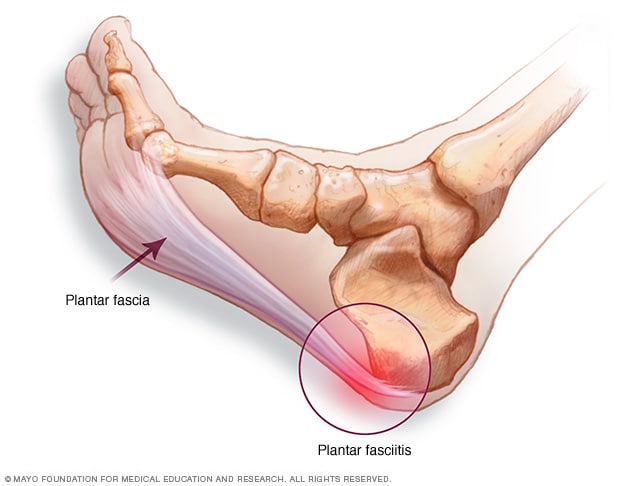
During my routine visit, I told Dr. Nick about my heel and he quickly shifted his attention to it. He poked, prodded, and pounded with his massage tool. Based on his assessment, he believed the issue was not a case of the dreaded plantar fasciitis, which, according to the Mayo Clinic, is "inflammation of the fibrous tissue (plantar fascia) along the bottom of your foot that connects your heel bone to your toes." This inflammation can require a substantial amount of rest to recover.

Illustration showing plantar fascia and location of heel pain

Instead, Dr. Nick believed the issue was related to one of the tendons that runs under the plantar fascia.
After a couple weeks of only taking Melanie for walks and avoiding my running routine (which I thought was best for speedier recovery), I was floored when Dr. Nick said "it should improve if you run." What? In fact, he expected me to run at least three times before our next appointment the following week.

A few days later, I laced up the runners and went for a jog with little or no expectations for a pain free run or feeling any better afterward. After my 3 miles, the heel felt pretty good. At the very least, the discomfort was not any worse. The real surprise came the next day.

To my amazement the next day, the heel barely hurt at all! Two days later, I ran 5 miles and two days after that, I ran another 4. I was not 100% pain free, but when I was out on the open road, I never thought about my foot.

I have had a couple minor setbacks with discomfort. One of these have been connected to trying to break in a new pair of shoes on a short 4-mile run. The rigidity of the shoes being the primary culprit for not allowing the foot to flex as much as it should.

A few days later, I ran 15 miles and experienced discomfort in my right knee and hip after mile 10 (I did not stop). Fortunately, this pain disappeared once I finished the run. The next day, I met with Dr. Nick and he said that the foot was still not where it needed to be and the knee and hip started to share the load. He sent me home with a couple of exercises to help stretch and strengthen the tendon. The following week, I ran a long-run of 18.6 miles and had only the normal muscle aches and soreness that comes with the distance. My foot did not flare up during or even after the run!

Am I out of the woods? Hardly. There is still some soreness and discomfort lingering but I keep doing my exercises and it seems to slowly be improving. I'll take it compared to how I felt in early July when I was seriously worried that I would have to defer the marathon until next year.

Sunday, August 4, 2019

Preston Park

Soon after I completed my early morning 11-mile run, I felt some discomfort in my right heel. No big deal, it was just my achilles being sore, I thought. I did a couple stretches and thought a day or two of rest would allow for sufficient recovery.

A couple days later, the heel still hurt. Every time I stood up and put weight on it, I felt surge of pain. The discomfort would slowly disappear after I walked on it for a bit, but overall, the heel did not feel good.

I took a couple more days off. In the meantime, the only exercise I did were some core exercises each morning and walks with Melanie.

After about a week, the heel started feeling better, so I decided it test it. I was anxious to continue my training. By this time, Jody, Melanie, and I were in western Pennsylvania visiting family. On July 3rd, Jody and I took Melanie to Preston Park in the Butler area simply because we did not know the lay of the land.

Preston Park is an interesting venue, to say the least. According to one website, "the park is a gift of nearly 100 acres from the late Jane and Dr. Frank Preston. Dr. Preston helped found the Western Pennsylvania Conservancy." When we pulled into the parking lot, had an eerie feeling to it. There was not another soul in the park and the previous night's heavy rain gave the wooded area a rain forest feel. There were some old conservatory buildings that had not appeared to be used in some time. I would not want to be here at night. The trails were muddy and the grass was completely saturated.

I started off on what I hoped to be a large loop trail. Less than 2 minutes into my run, I came to a muddy washout. I did my best to cross it via some tree trunks, but eventually slipped off and gave my shoes a nice new coating of mud. It did not take much longer for the rest of my clothes to be completely soaked from brushing up against all the wet branches and grass. At one point, I called Jody and said "This is stupid." My goal at that point was to make my way back to the car. Jody, was somewhere else in the park, pushing Melanie in a little umbrella stroller.

I did my best to follow the trails but eventually got turned around. After a few minutes of walking back and forth and staring at my Strava map, I found concrete and, soon thereafter, Jody. I was able to run a little bit more, but the the excitement of a morning run had since dissipated. I raised the white flag at the 3 mile mark and we drove back to my parent's house.


How did the heel respond to the hike? Not well. Similar to last time, soon after the run, it started to bother me again. I would sit down and after resting for a few minutes, the first couple of steps hurt like crazy. For the rest of the week, I limped around the house. I would not run again for over two weeks.


Sunday, July 28, 2019

20 Degrees

What a difference 20 degrees makes!

On June 26, I ran 6.12 miles at 11:30 AM, just about when the sun was at its peak. The temperature was about 81 degrees F and the sky was mostly clear with a light, breeze coming off the lake that teased my senses. I thought I should be able to knock out the 6 miles in no time. How wrong I was.

After the first couple of miles, my legs grew heavy and my pace started to slow. By mile 3, the sun had taken its toll. I needed to walk. I walked for a couple tenths of a mile, took a deep breath and started to run again. I'll be damned if I was going to walk the remaining 3 miles back home.

My paced was a bit slower and I had to walk again at the end of miles 4 and 5. When I arrived home, I was completely exhausted.


Pace of 6-26 run.
I guess I should not have been surprised by this result. According to this website, based on my height, weight, pace, and the fact that it was 81 degrees (F) outside, my body perceived the temperature to be about 110 degree (F)! No wonder I struggled.

The moral of the story: If it's going to be hot, run sooner.

If 6 miles was brutal in the heat, I could not have image what the next day's run of 11 miles would have done to me knowing that the afternoon temperature was supposed to be 84. So, I made a decision to beat the heat. I woke up at 4 AM (no alarm needed), put my contacts in, filled my CamelBak, and was out the door by 4:30. I needed to be back by 7 AM because Jody had to leave for work and I needed to watch the baby.

Typically, when I run a route longer than 10 miles, I usually eat a bagel with peanut butter about an hour before heading out the door. On this morning, I was not going to get up at 3 AM. Instead, I grabbed a few pretzels and drank a half of glass of water. That's it! During my run, I had one energy gel at about the 5-mile mark and a few pretzels that I had shoved into a plastic bag into my pocket.


I had some concerns that I might experience some linger effects from the previous day's run. These concerns never materialized. In fact, two hours after I started this run, I had never felt better after running 11 miles!
6-27 run. The pace is in blue and elevation is the grayed-out area on the bottom.

Sunday, July 21, 2019

Flying Pig: Post Race

It did not take long for me to realize that something was seriously amiss soon after I completed the Flying Pig. Sure, I was sore and achy, but this was to be expected. Alas, I didn't feel very good and I could barely put any weight on my right foot, which I took as a bad sign.

Jody was in no better condition. She did the half-marathon ... while she was five months pregnant! Sure, she walked most of it, but she still did it with minimal amount of preparation! Amazing!

There were no post-race selfies. Jody and I limped back to the hotel; all we wanted was a nap and a shower before our six hour drive back to Milwaukee. Alas, just getting back to the hotel was feat that mirrored the race itself. The three blocks felt like 10 miles. Every curb looked like Mt. Everest. We were not sure if we could cross streets before the light changed, even if we had a head start. I swear I heard a few cars rev their engines.

After cleaning up the room, we limped through the hotel and to the car. Each step I took hurt like a @#$%. This was not the typical post-race stiffness. My right foot and achilles were giving me serious problems.

I returned to the office the next day. For some asinine reason, I scheduled a meeting with a student. I work on the fourth floor. I've only taken the elevator a handful of times and this was one of those times. I walked around the office with a serious limp.

Three days later, I was in no better shape, but I decided to try to play golf. It's probably a sign that I should have skipped the round when I knew I needed a cart for the 9 holes. I hate carts! You just cannot get in a rhythm with them. I also forgot that I had to walk around the greens. Fortunately, I was able to hit the ball without any discomfort, though mentally, I'm sure the foot affected a handful of shots. Like at the office, I limped my way around each green. I shot one of the worst rounds of the year.

I never did see a doctor about the foot, but I'm pretty sure I did significant damage to the achilles, possibly nearly tearing it. I vaguely recall having a couple moments during the race when my feet didn't feel very good, but I just chalked this up to the heat and overall physical exhaustion. Reflecting back to the run, I wonder if my shoes were not the right fit. I purchased them in the final weeks of my training. They were fine for short distances but I never tested them for longer runs. I demoted the shoes after the run and have only used them for walks.

My next run would not be until June 11, over a month after the marathon, when I had aspirations of running marathon number two of that year...


Monday, July 15, 2019

Flying Pig: Lessons Learned

When it was all said and done, I was not too pleased with myself after the Flying Pig. Sure, I ran a personal best, but it felt far from it and I was not satisfied with the race. The year before, when I ran Green Bay, I felt absolutely elation when I crossed the finish line having run all 26.2 miles and I still had energy in the tank. I wanted that feeling again and Cincinnati did not provide it.

So what went wrong?

For starters, my goal time of 4:30 was completely and unrealistic. I should have tampered this once I realized how much faster it required me to run. My goal of my next marathon will be much more reasonable: 4 hours and 40 minutes.

I started too fast. My first mile was very slow, in part, due to all the people traffic. The first few miles were fine but then I got cocky. My pace started to push 10:00 min/mile.


I felt good! The air was cool. The cloud cover was deceiving. The energy of other racers was high and euphoric. I was going to shatter my PR!


I should have known better, especially from all the long runs where I petered out after running too fast out of the gate and not having enough energy to get home.

By mile 16 I was slowing down ... and still had 10 miles to go! By now, the sun was blazing and the air was much hotter. The clouds had disappeared. Runners had gone silent and the mood was one of survival.


In short: I did not pace myself well and fell into the all-too-common trap of running a race I could not run.

As it turned out, my training plan was not right one for me. I followed plan from the Strava website/app that is based on McMillan Running. I'll talk more about this in a later post. Suffice to say for now, this was a 12-week where each week was a combination of easy runs, long runs, and speed intervals. Come race day, I believe this plan hindered my endurance because it did not prepare me for the distance, because it assumed I could conquer the miles. By the end of the 26.2 miles, I was hurting and could already feel my legs screaming for mercy.

Preparing for a marathon is more than just running. What I wanted to do but was never disciplined enough to do was cross-train. This means doing core exercises, upper, and/or lower body workouts, walking, or some other activity. Sure I played some golf (always walking 9 or 18) on non-running days (and even on days when I ran) but this sport is hardly what one would be considered "cross training."

Diet is another significant part of the equation. I wanted to lose 10 pounds for the race. I lost about 6. Close but no cigar. During my 12 week workout plan, I had moments where I closely watched what I ate but I also had a lot of "loose" moments, meaning I fell victim to my sweet tooth's voice and the wrong mentality of "I'm running 4 days a week, I can eat what I want."


In sum, a lot went wrong in the weeks leading up to the race and all of this only added fuel to the flames of the weather and hilly conditions of the race. Hopefully, I can learn from these experiences.

Sunday, July 7, 2019

Flying Pig Marathon: The Race

Clear skies and 26 miles do not mix. As it turns out, bad math, over ambitious goals, and sunny skies (by the second-half of the race), really do not mix.

Starting line.
Per last week's post, my goal for the Flying Pig Marathon was 4 hours and 30 minutes (give or take a few minutes). Sounds reasonable until I mention the fact that this would have lowered my personal best time by nearly 20 minutes. Ha!

Even as I write that, it sounds silly. I've never been very good at math.

In order to knock 20 minutes off my personal best time, I would have had to run nearly a minute faster per mile ... for the whole race ... than I had ever run before. Not likely since I had only been training for about 12 weeks.

This goal set me up for a plan that was unrealistic. I thought if I ran the first couple of miles at about 11:00 min/mi, I could gradually increase the pace to reach the overall goal of 10:18 min/mi.

Not factoring into my goal time was the course. Cincinnati has hills. At least more than Milwaukee does. One hill in particular at mile 5 seemed to go on forever. I ran the hills strong but they definitely zapped my energy level. After the endless large hill, there were a series of rolling hills through some nice neighborhoods. The stretch was pretty it did not help my energy reserves.


And then there was the stretch on Route 50. It's been a year and a half since I ran the marathon and I vividly remember a few parts: the big hill at Mile 5, crossing the bridge from Kentucky back into Ohio (made for a great picture of downtown Cincinnati), and Route 50. Route 50 was the straw that zapped my back.

Route 50 is four lanes and we ran in one of the lanes on the southbound side. This stretch of the race was only a mile and half long but it felt like 10 miles. It hardly helped that it occurred at the 18.5 mile mark and, by this point in the race, the sun was high in the sky baking our fair skin. What skin escaped the beat down from above felt the wrath of the concrete as the sun's rays bounced at us from below off the concrete. There was no water along this route. The welcome relief of shade only occurred in the form of the overpass once we turned off the road and went under Rt 50. This lasted less than 10 seconds. I wanted to stop in this shady area, lay down, and let everyone pass me. Alas, I kept running.

By mile 22 I was still on pace for my goal. I was at an overall pace of 10:20 min/mi. Alas, to get to this point I had exhausted myself and still had about 10K left to run. By mile 22 my body had had enough and could run no further. I found myself run-walking the rest of the way home.
Mother nature did not help my race time. The race started with a lot of clouds but the sun made a strong appearance at about mile 10. The course had very little shade. The temperature pushed the upper 70s (and even higher along Route 50). To put his into perspective, during my training sessions in Milwaukee, I ran a total of TWO short runs in weather above 50 degrees and both of these were in the week leading up to the marathon! In short, my body (as well as my mental state) was nowhere near ready to run in "hot" weather.

Although 4:30 was out of the question, I made the best of it and still earned a personal best by a couple of minutes with an official time of 4 hours and 47 minutes and 59 seconds.

Sunday, June 30, 2019

Flying Pig Marathon: Toeing the Starting Line

On May 6, 2018, I ran the Flying Pig Marathon in Cincinnati, OH. The rationale for such an early marathon was that Jody and I were going on a babymoon at the end of May (a trip to Utah) so I could not run the Green Bay Marathon. And with Melanie due at the end of August, I could rule out any marathon after she graced us with her presence. Thus, to keep my annual marathon streak alive, we would drive the 6.5 hours to Cincinnati to run 26.2 miles.

In the months leading up to the marathon, I thought I had a good plan. I followed a different plan than the Hal Higdon plans that I had used in the past. This plan was from Strava and included a lot of speed workouts akin to sprints and interval training. I thought I would give strength a try over just running miles, which is the focus of most of the Hal Higdon plans.

I had a solid 12-weeks of training. Heck, I only I only missed one workout and came up short of my target mileage in another one when a massive snow storm hit Milwaukee on the day I was scheduled to run 20 miles. Instead, of running outside in blizzard conditions, I tried to run 20 miles on the treadmill. OMG! Worst experience ever! I binge watched Bosch on Amazon but could only muster 17 miles. Not bad, I guess, given that I was bored out of my mind after the fifth mile.


When it was time to leave for Cincinnati, I felt pretty good and confident that I could obtain my goal of a 4:30:00 race. I had even started to carb load a couple days prior to the race -- focusing on eating extra bagels, pretzels, and drinking a bunch of water ... but not too much.

The drive to Cincinnati was smooth and easy. and our our hotel was only a handful of blocks away from the running convention and starting corrals. 
At the time, I thought this was worth a picture...
The pre-race dinner was perfect. A bowl of spaghetti, bread, and water. The weather was even looking good. Maybe too good. No rain, but warm.

Overall, I wouldn't say I felt out-of-this-world great, but I felt good enough that I could achieve my goal to run the race in 4 hours and 30 minutes.

Thursday, June 20, 2019

New Shoes!

My last post occurred over a year ago. February 19th to be exact. I've been thinking of this blog for a while now and wondering if I should resurrect it. I'll be honest, I'm not quite sure why, but I'm hoping that it helps keep me motivated.

February 19, 2018 seems like a lifetime ago, and in many respects, a lifetime of events have happened in the nearly 500 days since my last post. On August 28, I experienced one of the ultimate joys in life with the birth of our daughter Melanie.


I also experienced the crushing sorrow that comes with the passing of a close family member when my sister passed away after a brief battle with cancer on December 15.


Both events put a perspective on what really matters: family. I never hesitated to keep the running shoes on the shelf for the past eight months (the exception being a Thanksgiving Day Turkey Trot).

In the coming weeks, I will have separate posts about what has transpired during the lost days as well as what I hope will happen in terms of my forthcoming running adventures.

This year, 2019, year is a bit different from all the previous ones now have a giggling, smiling, happy little girl to watch over and entertain. Running isn't quite the priority that it once was. Alas, I need something to keep the waistline at bay.

Moreover, I've missed it. Sort of. I haven't missed the sore muscles, aching achilles, and stiff joints, but I've missed the runs where the neighborhood is quiet and still. I miss the sense of accomplishment after a hard workout or long run. I also hope this year will be different because I want my daughter can be a part of some of my runs (more on this in another post).

A few weeks ago, I signed up for the Lakefront Marathon here in Milwaukee. I'm rusty and out of shape, but there are about 16 weeks before the race and plenty of time to just run. Let the chips fall where they may.

Bring on Lakefront!

Monday, February 19, 2018

Game On!

Holy !@#$%! Tomorrow I turn 40!


As nervous as I am about the big 4-0, I am also excited (I have a feeling it is going to be a very exciting year). And what better way to bring in a new decade of age with some marathon training.

Last week marked 12 weeks until the Cincinnati marathon. Training is officially on like Donkey Kong!

This year, I intend to run about 4 days a week and do some sort of cross-training, such as PiYo, yoga, or other P90X routine, at least one day a week.

It will be interesting to see how the numbers for this year's training regiment compare to the previous two year's, especially knowing that they were 18-week programs. Comparing the results from 2016 and 2017 (data from MapMyRun):

Monday, February 12, 2018

Bump on a Log

It's hard not to be a bump on a log during the winter in Wisconsin. This year, in particular, I have had to drastically shift some of my routines in an effort to stay in some semblance of shape.

In November of last year, my wife and I moved into a new house north of Milwaukee.

New house! I accidentally posted this picture on last week's entry (but removed it later)
It's wonderful, peaceful, and quiet but there are a few drawbacks when it comes to running.

First, there are no sidewalks. While running on the road has never bothered me, some of the roads are a bit narrow with little if any shoulder. Also, I'm not sure how many runners there are in the area, therefore, I'm not sure how aware drivers are about runners, especially early morning runners.

Second, the neighborhood lacks street lights. The best lighting comes from smaller lamp posts at the end of driveways that are hardly enough. Back in December, I ran once with a headlamp. Of this experience, I can only say that it was better than nothing but the light was either too low or too high and I eventually ripped it off my head and ran with it in my hand. I have another headlamp that I will try before investing in another one.

Third, the roads in our division are not a high priority when the weather turns, so they they are a bit dodgy when covered with snow and ice. They barely salt the roads and when they do, it is a combination of sand and salt, so it hardly clears the road. Add this to their narrowness and darkness and the risk level is pretty high when conditions are less than ideal.


Fourth, I'm simply not familiar with the area. We moved the week of Thanksgiving and between the holidays, short days, and the weather, there simply has not been a lot of time to familiarize myself with the roads and their turns, and be confident in my routes. As Spring approaches, the days grow longer, and the conditions improve I am sure my confidence in the roads will also improve.

Despite these limitations to running outside, I have not been a complete bump on a log.

There were many appealing features about the house we bought, but one of them was that it had a finished basement. I believe this room may become my man cave (if the wife allows it) but for now it is the workout room.

For the past several weeks, I have used the space to do a few cardio routines, yoga, core and strength training exercises. The goal as been to do something as I start to prepare for Cincinnati. Sure, I'd rather be outside pounding pavement with my feet, but this space suffices and I prefer it to going to the gym. But as I will explain next week, in a way, I did buy a gym membership.


Tuesday, February 6, 2018

Another Year, Another Marathon

The drive to run another marathon has been percolating under my skin for a few weeks. Even as the cold wind blows and the streets are covered in snow and ice, I could never completely curb the idea of running another 26.2 miles.

This year, I wanted to run something other than the Green Bay Marathon. It's nice and all but after a couple years, a change is scenery is always a good thing. I had initially thought about the Fargo Marathon. It has received great reviews (yes, people review races) and, North Dakota might as well be a foreign country to me. Not exactly sunny skies and warm beaches, but exotic for its own vastness.

North Dakota as seen from I-90.

Alas, after talking with my wife, we decided that this year we want to go on our summer vacation at the end of May, so this ruled out Fargo, Green Bay, and a few others.

Summer marathons have never appealed to me because I am not a fan of training during hot summer days. I was miserable when I prepared for the Chicago marathon several years ago (obviously being woefully clueless about how to train did not help). Besides, if last summer was any indication, I am going to favor my golf shoes over my running shoes from June to August.

So this meant that the marathon had to be run at the beginning of May. Surprisingly, there were a couple options: the Pittsburgh Marathon and the Cincinnati Marathon. Both have received excellent reviews as being exceptionally well organized, strongly supported by the community, and very "scenic" routes in the sense you see a lot of each city. I would love to return to my home state and run across all the bridges, but...

Since the races are on Sunday and school is still in session at UWM, I need to return to work on Monday, even if it is with a limp and a grimace on my face. Cincinnati is about 6.5 hours away while Pittsburgh is about 9.5. The former will make for a much more manageable drive after the race. So, I decided on the Flying Pig Marathon.


I almost did not get in. I dragged my feet registering for the race and only did so at the very end of January, the day before a $10 price increase. Apparently, I was not alone. When I went to register in the evening, I was greeted with this message: 


Sure enough, for the first time EVER, the marathon sold out! The reason being that it is the race's 20th anniversary. I put my name on the wait list and then started to think more about Pittsburgh. Fortunately, I did not have to think about Pittsburgh for too long. The next day, the organizers opened up the registration to those individuals on the wait list. Upon receiving the email, I did not hesitate to sign up for the race on May 6. Let the training begin!

Monday, December 18, 2017

Smart(er) Golf

Golf is a game where one is never too old to learn how to play smarter golf. I frequently play with a guy who, during almost every round says "I wonder what would happen if I played the smart/safe shot for an entire round?" Inevitably, this is said after he tried to hit a shot so his ball would split a six inch gap between two trees only to "come so close" and have the ball go deeper into the woods.

I've often wondered why we feel the need to play beyond our own game and capabilities? Why is it that we believe that we can hit the most difficult of shots even knowing that we are not quite sure where the ball is going in the best of conditions? I guess it's because at one point, we did hit the miracle shot and believe that we can repeat that feat, or we say to ourselves "how hard can this be?" We are gullible creatures.

I'm not saying I always make the perfect decisions during around. I often stand over a shot and think "all I have to do is hit a little fade around that tree and I'll be sitting pretty..." Funny how the tree moves into the path of my ball the moment after I swing.

Golf is a lot like risk management, or would a better analogy would be that golf is like damage control.

There are a million reasons why pro golfers are pro golfers, but one of the ways that they truly separate themselves from the rest of the pack is because they they go to great lengths to play the "safe" shot and do their best to avoid the danger areas on the course.

What does this mean? Here's an example:

The following images are from Google Earth; they are of the hole at Currie Park in Milwaukee, a 353 yard par 4. Seems simple enough, eh? A slight dogleg to the right with a bunker on the left side. The end of the trees on the right are about 120 yards from the green. The green is relatively level with a slight slope from back to front and right to left.


So let's think strategically about how to approach this hole, starting at at tee box.

When teeing off, where are the obvious no-no areas? Areas where if you hit them, you are most likely going to lose a stroke (or two) to needing to hit a recovery shot?

The answer: the trees on right. The trees on the left. The bunker short-left of the green.


This holes plays to the strength of a person who hits a slight fade. He/she can aim up the left side of the fairway (or even at the trees on the left) and let his/her natural curve take the ball to the right. Obviously, if one does not aim far enough to the left, or has a significant curve (*cough* slice *cough*) then the trees on the right side will suck up the errant shot. I can vouch for this happening on more than one occasion.

So, off the tee, a decision needs to be made: risk ballooning a ball into the trees to the right if the driver can be temperamental and prone to spells or erratic behavior, or play it a bit safer by hitting a 3 wood and increasing the likelihood that the ball will find the fairway even if it is a bit further back?

The smart shot is the 3 wood.

Now, let's scenario play the second shot.

Let's say you hit a good drive (or 3 wood off the tee) and have about 150 yards left to the center of the green. The pin is short left (the blue dot). You are in the middle of the fairway (I know, keep dreaming ... but you need positive thoughts). The question is, how do you approach your next shot?

If your iron play is not very accurate, where do you want to be if you miss the green?

Looking at the next picture, there are two big no-no areas: the bunker and the rough to the left of the green. These areas are bad because they are on the short side, meaning there is very little green to work with; and from this distance it is very difficult to stop the ball close to the pin (remember, you would be coming downhill too). Leaving your second shot in these areas means there is a very good chance you will try to get too cute with your next shot and either blade it all the way across the green or, more likely, chunk it and move the ball six inches forward but short of the green.


Long-left (purple area) is far from ideal but at least you have more green to work with. The area marked in yellow would be considered the safe bailout zone. You would have plenty of green to work with, so any pitch would simply need to land on the green and start rolling towards the hole. It might be difficult judging the distance out of the rough, but they key is that there is room for error.

If you came up short of the green but still in the fairway, it would be better if you were more to the right (orange area) than the left (blue area). This is because there is more room to work with with the former than the latter. Also, in both locations, you would be coming uphill which would help control the pace of the ball on your next shot.

What all this means is that short right is okay, as is a bit further to the right.

If I'm thinking about the green, simply being on the proverbial dance floor may not mean an easy two-putt-par.

Looking at the next image, ideally you will be under the pin and maybe just a bit to the right (yellow area). This would leave you an uphill putt. It's pretty clear with this hole, and the pin location, that it is a pretty small target area so there should not be any screams of frustration if you miss this location.


Your next best option would be on the "fat" side of the green but somewhat close to pin high (the dark blue area). Placing the ball here means you've taken the bunker and the left side of the green out of the equation -- two no-no areas. This should make for a relatively easy two putt and par -- no harm done on the first hole.

If you go a bit long and right (purple), you are still on the green, but the downhill putt and distance might make two putting a bit difficult. If the conditions are dry, you might find yourself off the green with your next putt.

Finally, the least ideal spot would be the red zone because there is simply not that much room for error coming back down the hill. Also, placing the ball here would mean you've flirted with missing the green to the left which is "dead."

So, when I am looking at this green from the fairway, I would focus on zones 1 and 2. Chances are, I may not even look at the pin when aligning my shot knowing that I want to be to the right of it. This means I want to pull a club that will go about 130-140 yards (assuming the middle of the green is about 20 paces from the front) and not much further.

For this hole, with this pin, it is better to be short than long and to the right of the green than to the left of it.

So, there you go: smart(er) golf. Yes, it involves quite a bit of analysis but when applied, playing smart(er) golf can definitely save a few strokes each round.
Monday, December 11, 2017

Golfing

A few weeks ago, I mentioned that I played a fair amount of golf this summer. To deviate a little bit from the running posts, I am going to make a few posts about my other passion: golf.

I have been playing golf since middle school. Maybe my dad will know when he first handed me a golf club and started to tear up the grass next to the garage. Maybe I was 9 years old. I don't remember. However, I do remember the first time I ever tried to hit a golf shot on a golf course.

My dad took me and another friend to a local Par 3 course. I squatted down to tee up my ball. I sized up the green that was about 1,000 yards away to my young eyes. Nonetheless, I licked my lips in anticipation of hitting a sweet shot that would rocket off the club face, arch high in the sky, and land softly on the green. I could almost hear the roar of the crowd applauding the shot.

I pulled the club back and with one mighty swing ... I shanked it into the pine trees immediately to the right of the tee box.

A natural I was not.

But I kept playing ... and playing ... and playing.

There were a bunch of lessons. There was golf camp (twice). There were a couple years where I played in summer tournaments. I played all through high school. I had intentions of playing in college too but after trying out my freshmen year and not doing very well, I lost interest in the game and would only play the occasional round for the next several years.

An unfortunate decision on my part.

To this day, when I go to the driving range, it only takes me a few swings to find my rhythm regardless if I haven't played in a week, a month, or six months.

When I return to the course after a long absence, I quickly realize how much I miss playing.

Looking back, I now know that I had the game but not the mental fortitude I needed to take it to the next level. I never learned how to play "smart" golf and manage a course. I lacked focus and, more importantly, confidence that I could play along aside golfers who were bigger and stronger that me.

This said, I'm glad I am finally able to play on a regular basis again and apply some of the lost lessons.

Monday, December 4, 2017

Green Bay Marathon

Looking at my list of posts that I started to draft but never finished, I noticed that I never wrote about my experience with the Green Bay Marathon that I ran at the end of May.

The morning of the marathon, we woke up to the sound of rain. In the hours leading up to the race, it rained. And it rained hard. And it rained some more.

Jody and I, like a lot of others, huddled in Lambeau field, not wanting to venture outside until the last possible moment. Then they called people to the starting corrals.

Standing in the starting corrals, it continued to rain and did so even after the starting gun went off.

But then, after the first few minutes, the rain stopped and it never started again. Even better, the clouds stuck around. There were a couple moments where the sun peaked through small gaps in the clouds and turned the course into a sauna. I cursed the heavens but let out a sigh of relief when the sun disappeared again.

My goal was to run a sub-5 hour race. I spent hours using Races to Remember to calculate my splits. What happened if I started off really slow? What would be the fastest pace that I could realistically hold for the last 6 miles -- after encountering the dreaded wall that I have hit each of the past two marathons? I calculated even splits, negative splits, "anti-cramping" splits, and even options in between. I became dangerously obsessed with the site.

What it all boiled down to was that I convinced myself that no mile for at least the first 12 should be faster than 11:00 min/mi. For the most part, I accomplished this.


Next, depending on how I felt, I could stick with this pace or increase it by a little bit. I knew if I stuck around the 11:00 min/mi I could reach my goal (a time of 4:55 averages to about an 11:15 min/mi pace).

I felt really good at the halfway point. I did my best not to get too excited. I tried to maintain a pace as close to 11:00 min/mi as possible but gradually inched my way south of the 11:00 min/mi mark.

Then, something crazy happened. As I approached mile 20, the spot where I crashed and burned last year, I caught up with the 5:00 hr pace group. I had previously thought that this group was behind me, but apparently, when I stopped twice to use the bathroom (around miles 2.5 and 5), they had passed me. Anyway, the leader of this group abides by a walk-run philosophy. They run for about .75 miles and then walk the last quarter.

When I caught up to them, they were running. And they were running fast. I ran with them. And I continued to run with them. They were going too fast for my liking, but I did not want to stop or slow down. Something clicked in me where I was determined to pass them! At one point, in my head, I screamed "Please start walking!" because I did not think I could maintain the pace ... which was closer to 10:00 min/mi. Just about as I felt my legs start to burn, the leader of the pack yells "And we're walking!" Thank goodness!
The moment when I caught up to the 5:00 hr pace group.
I kept running!

For the first time running a marathon, I did not let my head get in the way. I told myself that I was going to bust through the wall at 20. I was not going to stop!

For the next six miles, I kept the legs turning. When I hit a rough patch, I focused on my breathing to relax me and get my mind off my aching body.

When I approached Lambeau field (mile 26), surprisingly, I felt strong. I felt good. I ran my lap around Lambeau and even flashed a smile and thumbs up to the camera guy.

A thumbs up and smile in Lambeau ... at mile 26.

When I exited Lambeau and hit the slight incline to the finish line, I pushed myself to finish strong.

It might be hard to see, but at the far right is my "sprint" finish.
Not only did I achieve my goal of running a sub-5 hour marathon, I crushed it! My "gun time" was 4:55:04 but it took me a few minutes to cross the starting line. My watch and chip time gave me the same number:

I'm not sure what is next (okay, I have an idea), but I am going to remember this feeling (and what it took to reach and surpass my goal) for quite some time!

Monday, November 27, 2017

Following the Steps

I am not going to lie, I think about my safety a lot when running. I'm not talking about being mugged or robbed when I am out, but I do think about the traffic. I no longer run with headphones so this helps me stay more aware of my surroundings, but still, many drivers are oblivious to runners.

To be honest, I cannot blame all of them. Aside from simply not paying attention, often it is because I run in areas where it may not be that common to encounter runners. Also, I run through a lot of neighborhoods with intersections where the cross traffic does not stop or people do not have a good of a range of vision when backing out of their driveways. It's amazing how many people fail to look both ways or check their surroundings when driving.

My head is often on a swivel when I run and I have had to make a quick move to the side or apply my breaks to yield to the unaware.

For runs over a few miles, I will carry my phone, driver's license, and medical insurance card. I realized last year that as reassuring as it may seem to be carrying my phone, it is not a full-proof option. What happens if it breaks during a collision? What happens if the battery dies during one of my runs? How will anyone know to call Jody? I have her listed as my ICE (in case of an emergency), but will people know to look up this contact?

As a backup, I made a couple slight investments to minimize these risks.

First, I carry (not necessarily wear) an ID wristband. This wristband has Jody's contact information on it as well as our home address.


With this wristband, my phone can quit working and there is still a way to get a hold of her in case of an emergency.

The other service that I also use is Strava's Beacon. This a feature that comes with a subscription to Strava Premium, which costs about $6 a month. When I start my run via the Strava app, Beacon allows me to send a link of my run to anyone I like. This allows the person who receives the text to track my progress in real-time (with a minor delay). She can also see my phone's battery life. More importantly, she can tell if I have stopped for no apparent reason and where I stopped.

Beacon has also allowed Jody to determine when and where she decides to run with me. In the past, Jody has started my long runs with me because it is easier this way. She had a couple attempts to join me towards the end of my run, but this proved difficult. I would print my route but, the problem was, I have been known to deviate from these plans to avoid construction, hills, or because I just was not feeling the original path.

Now, with Beacon, I can deviate all I want and she is still able to follow along. She can take a couple educated guesses about my intentions, especially when I return to our neighborhood. So far, she has had only success "finding" me and joining me in the final stretches of my runs.

Monday, November 20, 2017

We Now Return To Our Regularly Scheduled Routine

Wow! It has been a while since I posted one of these entries. I've been thinking about them for a while. I've also wondered if I was going to let them fade into the pale blue yonder or try to resuscitate them so it can breathe for another day. Nothing like giving CPR to an inanimate blog.

For the most part, I stopped running during the summer. I had the occasional spurt of activity but the runs were few and far between. Instead, over the summer, I played golf. I played a lot of golf.

It's been a while since I had a summer where I played a couple times a week and had a handful of trips to the driving range. I purchased a new set of clubs in late March and, during my first round using them, had my first hole in one! However, not all rounds were this gratifying. At one point during the season, I developed a bad case of the shanks. Despite all the ups and downs, it felt great to play with some regularity again, even when the game wasn't in a good spot.

Alas, we do not live in Florida, so I cannot play all year. Colder temps and fallen leaves means the golf clubs are just about ready to be stashed away until next year. *Sniff* I might try to squeeze in occasional round, but with the shorter days and other obligations, it will be difficult to justify.

With the end of season, another must start. It's time to start running again!

I've realized that I prefer to run when it is cold -- sometimes "bitterly" cold outside. I find crisp and cold mornings to be be calm and quiet. There is just a general sense of peacefulness when running in the early morning hours as most people are huddled under their blankets. I can think of only a few better ways to start the morning.

Sunday, June 25, 2017

Tale of Two 20-Milers

Once I set my training calendar for any marathon there are a few special runs that loom large in the later weeks of the schedule. There are a few races that I mentioned in my previous post and there are the 20-mile runs.

This year, the first run occurred on April 15 and the second two weeks later on April 29. The runs could not have gone any differently.

April 15

I had started to think about this run for over a week before it happened. I did not run the preceding week because of a conference in Omaha and some bad weather. On Sunday the 9th, I ran 13 miles and it kind of sucked.

I did run three other times during the week with no notable struggles or frustration, so there was some cause for optimism.

On Friday night, I made my first mistake. For some reason, I thought that if I ran the distance at a slower pace then what I ate for dinner would make little difference. I was wrong. That evening, as Jody and I walked around the grocery store thinking about what to have for dinner, we stopped by the fish fry station. What could go wrong?

On Saturday morning, the weather was nearly perfect. I loaded up my water belt with one bottle filled with water and the other filled with a diluted mixture of Gatorade and water. I also took my GUs. The first 15 miles were okay, but there was some discomfort in my left heal/achilles area. At just past the 15-mile mark, I crashed into the the wall.


My body ached. My stomach was not feeling 100%. I had no energy. I walked walked for about 1.5 miles and it was pretty clear that I did not drink enough water. Jody joined me for the final half of mile and basically dragged me to the "finish" line.

Pace for the first 20-miler. Notice the sudden drop-off in tempo near the end.

April 29

I had yet to run one good 20-mile run. A couple weeks after the disastrous fish fry incident run, I sought to right several wrongs. First, I prepared the night before like I should. No fish fry. We kept the meal as simple as possible with some carbs and protein. I believe we had some pasta, fish or chicken, a light side of vegetables, and some bread.

My second goal was to break up the 20-mile run into two manageable circles. The first half was a loop of about 12.5 miles and the second, smaller loop was about 8 miles. Halfway through, I intended to stop at the house for a very short break to use the restroom and fill up my water.

Route for second 20-miler. First loop indicated by black arrows; and the second loop indicated by green arrows.
The third goal was to run slower. Much slower. I wanted to run the entire route, so I tried to flush it from my head that I needed to keep up a certain, unrealistic pace. I had it in my mind to run the first half or more at no faster than a 12:00 min/mile pace. After those miles, if I felt good, I could pick up the pace a little but only if I felt okay. At no point, I told myself, should I come anywhere close to running at a 10:30 min/mile or faster pace.

Finally, I opted not to run with any Gatorade. From what I've read about long runs and nourishment during them, electrolytes are very important, so water is not enough. But Gatorade also has a lot of sugar that disagrees with my stomach on long runs. So I took a chance by leaving the Gatorade in the refrigerator. Instead, I took my Camel Pack that holds 50 oz. of water and loaded a small snack bag with some pretzels. These would give me a few additional carbs (besides the GUs that I had every 5-6 miles) and some salt to help retain water.

What a difference these changes made!

The two loops made the run mentally easier to manage. In the past, I have often become frustrated at the thought of how much further I have to go on these long runs and this can be as equally zapping of energy as lack of hydration. Also, the break in between the two loops gave me an opportunity to fill up on water so I did not have to worry about rationing water for the rest of the run. The loops also allowed Jody to run with me as I approached the house at the end of both loops (I'll explain how she knew where I was in another post). It is always awesome to see her when the miles start to accumulate and I need a bit of encouragement.

Here's the other kicker: I ran the second loop at a faster pace than the first loop simply because I felt like I could. It's not like I was pushing the pace so hard that my body was screaming at me to stop. Nope. I just ran in my comfort zone which was at about a 10:45 min/mile pace. This is even more surprising because of a nasty hill at the 17.7 mark that did not halt my momentum. 

Finally, as I approached the 20-mile mark, I still felt like I had gas in the tank. My legs and hips ached but were not screaming for me to stop. I easily ignored their grumblings.

As I made the final turn for home and saw Jody at about the 19.7 mark, I gave her a big smile and thumbs up. She started to run with me but after the watch chimed my twentieth mile, I shifted gears one last time and nearly sprinted to the 20.2 mark. I finally believed that I could have run 6 more miles. 

Pace for the second 20-mile run. The spike at about mile 13 is when I stopped at the house. Note the sudden burst of speed at the very end.
Talk about a mental hurdle that I needed to overcome. It took 15 weeks, but I was excited that I could run a sub-5:00 hour race in Green Bay.

Monday, June 12, 2017

Races

As my training had its ebbs and flows, there were three races prior to Green Bay: Steven Cullen 8K in January, the Lucky Leprechaun 7K in March, and the Door County Half-Marathon in May. I had run all three races the year before so I could use them as some type of barometer to determine if I had made any progress. However, because I felt that my training had been more miss than hit, I did not have high expectations for any of these races.

Steven Cullen 8K

This race was in Wauwatosa in early February. Unlike last year when it was -10 degrees at the start, this year it was a balmy 40 degrees. Despite my goal to run an "easy" race, soon after I started, I pushed myself.

Overall, my time was about a minute slower than last year's run:

2016: 0:43:14 (overall time) / 8:38 (pace min/mi)

2017: 0:44:01 (overall time) / 8:48 (pace min/mi)

Not bad considering I had been sick the week before. While not 100%, I was still able to gut it out and finish strong.

Lucky Leprechaun 7K

Jody and I have run this race the past two years. It is a great race. In particular, we like the course as you are always around people and make enough turns where you never get board of running in a straight line.


Once again, my confidence was not too high for this race. I would have been happy with any time around a 9:00 min/mi pace, but soon after we started, I felt good enough early to crank up the pace and beat last year's time.

2016: 0:36:15 (overall time) / 8:20 (pace min/mi)

2017: 0:36:08 (overall time) / 8:19 (pace min/mi)

Door County Half-Marathon

This was the third consecutive year we have ventured to Door County to run the half-marathon and its 5K. It is just a great race. The venue is perfect and it is a nice excuse to get out of Milwaukee for the weekend. The timing is also ideal as it is about three weeks before the Green Bay Marathon.


This year, I was torn how to run the course. Do I push myself and aim for a new PR? Or do I hold back, enjoy the race, and save my energy for Green Bay?

Even after the gun went off, I still had not made up my mind. I started fairly slow, but wanted to keep the 9:00 min/mi pace group within site so I could still achieve a sub-2:00 hour race if I felt good enough.

For the first 10 miles, I stuck close to the 9:00 min/mi pace group. At about the halfway point, I pulled ahead of the group but could hear them on my heals. Then at about the 10-mile mark, something crazy happened. I stepped on the gas. For the last three miles, I ran at about an 8:30 min/mi pace. With about two-tenths of a mile to go, I found another gear and finished with a mad sprint, passing about six people in the process.

Last four miles of Door County Half-Marathon  measuring my pace (blue line). Note the surge, or mad sprint, at the very end. The gray area is the elevation.

2016: 1:57:24 (overall time) / 8:58 (pace min/mi)


2017: 1:56:31 (overall time) / 8:52 (pace min/mi)

Overall

Despite my concerns that my training for Green Bay was not going well, from the race results, it was going well enough. And after the Door County race, I had reason to be optimistic that I could reach my goal of running a sub-5-hour marathon.


Sunday, May 28, 2017

Training Challenges

As I trained for Green Bay, I experienced more challenges this year than I did for last year's race and the Chicago Marathon -- combined.

Sickness
At the end of January, a few weeks into my training, I was laid up for a week due to a nasty head cold. After a 10 mile run on Sunday, January 29, I spent the rest of the week fighting the cold that drained all my energy and required me to use about five boxes of Kleenex. I did not run again until Tuesday, February 7.

Injuries
On February 16, I ran a faster tempo run (a fast-paced, 3-5 run that is at about 90% capacity) after a long day at the office. Though the run felt good, soon after I was done, my right hamstring felt less than wonderful. I started to apply ice that night. I did not run the following day. On Saturday, I ran 7 miles and the hamstring loosened up after the first mile. I thought I was out of the woods with the injury until about a week later when, I notice it bothering me on another 7 mile run.

The next day, Sunday, I ran 9 miles. As a consequence of the hamstring injury, my body placed more stress on my left leg. This equated to the development of my very first shin splint. For the rest of Sunday, it felt as if someone had kicked me in the lower left leg. The following day, I traveled to Florida to see family. Walking around the airports hurt like no other. Despite my intentions to do so, there was no running in Florida, just rest and ice. Fortunately, this seemed to do the trick as I was able to run 8 miles on Saturday, February 4 and 14 miles the following day without any discomfort. The shin split never returned.

Weather
This year it was harder to roll out of bed in the morning when it was dark, cold, and windy. Gotta love Wisconsin winters. Compared to last year, there were a few more days this year where roads and sidewalks were covered in snow and ice, so I had skipped running on these days ... and slept.

Training Program
My original training was too ambitious. The original plan was to run 5 days a week. After my long runs on Sunday, the schedule called for me to run 3-5 miles on Monday and then 7-10 miles on Tuesday. Mentally, I could not do it. I needed a day (or two) to recover from my long run on Sunday. Also, I prefer to leave for the office (to avoid traffic) by 6:45, so this made running 7-10 miles on Tuesday difficult without waking up at 4 AM (and I struggle to run after work).

By the end of March, I adjusted my plan so Monday was a rest day, Tuesday was the shorter run (3-5 miles), Wednesday was a bit longer (5-7 miles), and Thursday was a different type of workout (i.e., tempo run, sprints, hills, etc.). Friday was a rest day and the weekend consisted of two runs: a shorter run on Saturday and a long run on Sunday. This planned worked pretty well, though Thursdays became more of rest days too given a pattern of crappy weather, personal travel, and lack of ambition.

Moral of the Blog Post
I realized that if I took a week off, or even a couple days, nothing significant happened. There was no a drastic regression in my strength. I was still able to run my long runs on Sunday and, as the times in the few races I ran prior to the marathon indicated, my speed did not suffer. In fact, I would venture to guess that being overly cautious about the injuries helped minimize my downtime.